Mini Split Installation in Brockton, MA
A new system here will heat from October through May and cool from July through August every year. Tell us about the house, and a licensed contractor who covers Plymouth County will get in touch.
Tell us about the job
It takes about a minute.
What Brockton winters ask of a mini-split
Brockton needs heat eight months a year, October through May, with winter nights averaging 23°F. A mini-split installed here has to hold up through most of the calendar, not just take the edge off a few cold snaps. Summer is short by comparison, two months of afternoons near 80°F, so the system spends far more time heating than cooling.
Any mini-split installed new has to meet the federal minimum for split-system heat pumps, 14.3 SEER2 for cooling and 7.5 HSPF2 for heating. The area has also logged 61 winter storms and 346 damaging wind events over the past ten years, and about 1 in 10 Massachusetts households went at least 24 hours without power in 2024. Worth asking, before installation, what the mini-split does if the power drops.
- 8 months
- October through May, your system heats
- 2 months
- July through August, it cools
- 23°F
- the average winter night it heats against
- 80°F
- the average summer afternoon it cools against
NOAA nClimDiv, 1991–2020 normals
- Is a mini split worth it?
- For most homes here, yes, especially for a room that doesn't have good duct access, like an addition or a converted attic. Brockton winters get cold, down to 23°F on average overnight in December through February, so the unit needs to be rated for real cold weather performance, not just mild climates. A cold-climate mini split can still pull heat from outdoor air well below freezing. Where it makes less sense is trying to condition an entire house room by room with several indoor heads when ducted equipment would do the job with one system.
- How many rooms can a mini split cover?
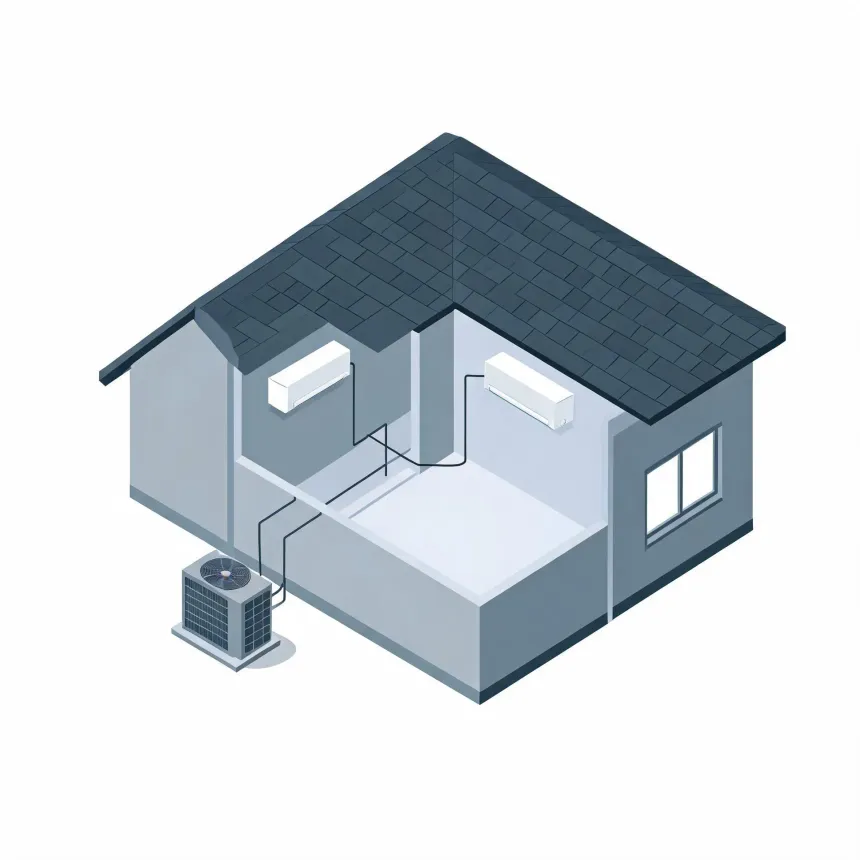
- A single outdoor unit can run one indoor head or several. Multi-zone systems let one outdoor compressor power several indoor heads, each one controlling its own room independently. The tradeoff is that each added zone splits the outdoor unit's total capacity, so a contractor needs to size the system based on the square footage and heat loss of each room, not just the number of rooms you want covered.
- Can a mini split heat a whole house?
- It can, but it depends on the layout and how many zones the house needs. An open floor plan with one or two mini split heads might get fully warm. A house with several closed-off rooms usually needs a head in each one to heat evenly. Brockton winters run October through May, with nights averaging 23°F in the coldest stretch, so the system needs enough total capacity and a low-temperature rating to keep up on the coldest nights, not just handle typical fall and spring days. A contractor can calculate the heat loss for the specific house and tell you whether whole-house coverage is realistic with mini splits alone or whether some rooms need a different approach.